


When the State Loses Direction, the Protest Points the Way
Doron Stern
In recent months, there has been a growing political and media discussion about "Civil Disobedience" as a reaction to the government's dysfunction in Israel, and the ongoing crises in the security and legal system arenas.
The rationale for the government’s actions, or sometimes, its inactions, has led to sharp public criticism. The failure to return the hostages, the stagnation of the military campaign in Gaza and its toll on casualties, progress on judicial overhaul, limiting the powers of the Supreme Court, controversial political appointments, the unresolved issue of drafting the ultra-Orthodox, and the transfer of sectoral budgets, all deepen the feelings of alienation and crisis of the public. Considering all of this, more and more citizens, as well as former high-ranking figures in security, legal, and political circles, view non-violent civil disobedience, such as strikes, blocking roads, or symbolic refusal to pay taxes, as a legitimate and necessary way to fight for the country’s future and push for changes in government policy.
Civil disobedience is defined as a public, non-violent act in which citizens knowingly choose to disobey laws or government directives. These actions come from matters of conscience, with the intent of protesting and bringing about changes in the government's policy.
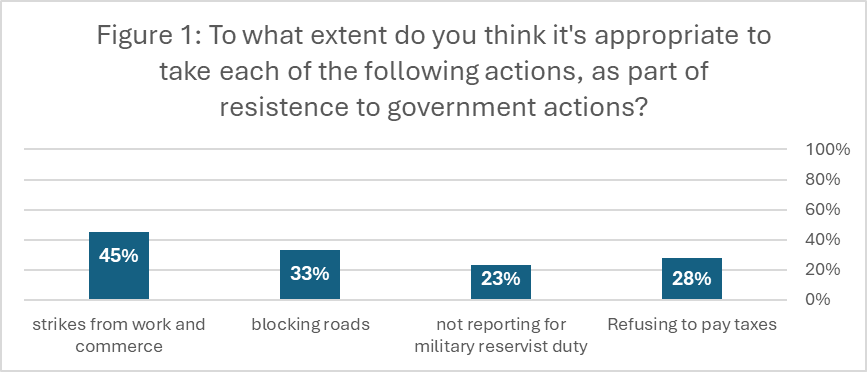
A survey conducted by the Institute for Liberty and Responsibility at Reichman University in May 2025, examined whether the public thinks civil disobedience as a resistance to government actions is legitimate. The survey looked at four forms of disobedience: refusing to pay taxes, refusal to report for military reservist duty, blocking roads, and strikes from work and commerce.
The results show that 45% of the public think that striking from work and commerce is the most legitimate form of civil disobedience. In contrast, there seems to be little public legitimacy for not reporting for reserve duty as a protest: only about 23% see it as legitimate.
 |
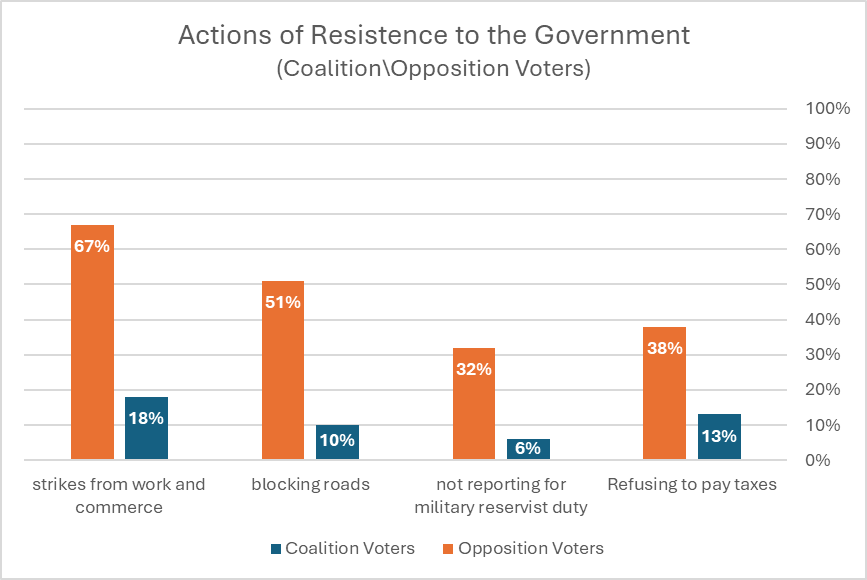
There are big gaps between coalition voters and opposition voters regarding the legitimacy of resistance to government moves. These differences mainly stem from political identification and the level of trust each group has in the current government. Coalition voters, who view the government as representing their positions, tend to oppose protest actions. For them, such actions are seen as illegitimate towards a government that was democratically elected. On the other hand, opposition voters feel alienated, frustrated, and distrustful of the government, which they see as responsible for the crises and failures. Therefore, they are more likely to support civil disobedience and non-violent protest. For them, actions like strikes (67% support among the opposition versus 18% among the coalition), blocking roads (51% compared to 10%), or refusing to pay taxes (38% compared to 13%) are seen not only as legitimate but even necessary for applying pressure on the government to change its policies.
 |
In addition, there are differences between Jewish and Arab citizens in how they perceive the legitimacy of such protest actions. These gaps stem from a longstanding sense of alienation among Arabs towards state institutions, experiences of exclusion, discrimination, and a lack of trust in the political and public system. For many Arabs, protest actions are seen as a tool for expressing dissatisfaction, especially when they feel formal channels for influence are closed to them.
The findings show that within the Jewish public, there is not wide support for civil disobedience practices. Even among opposition party voters, only strikes from work and commerce get a majority as a way of resisting government actions. These numbers point to a deep reluctance to break the law or take steps seen as harming social stability. The public’s emotional and historical connection to institutions like the IDF, the legal system, and the economy, leads to hesitation, even among government critics, over radical actions that might undermine the foundations of order.
The public distinguishes between legitimate political criticism and actions that could cross the accepted boundaries of civic action in a democratic country.
In a reality of sharp political polarization and loss of trust in government, the appearance of protest actions, even if controversial, reflects the public’s feelings of alienation and frustration. Considering the threats, losses in life and property, the lack of a political horizon, and populations still displaced from their homes, some groups feel the country is losing its way.
Even if one cannot accept or justify protest actions that deviate from the law’s allowance, it is crucial to recognize that such actions come from accumulated frustration with controversial government actions. Seeing protest simply problematic, without recognizing its root cause, weakens the ability to understand the core of the conflict.
In the end, civil disobedience, even when non-violent, is a sign of a break in public trust. The deeper this break becomes, the greater the risk to the strength of a democratic society.
Therefore, the real challenge is not only dealing with different protest methods, but creating conditions for restoring trust, open conversation, and dialogue, as part of the effort to preserve social cohesion and the democratic system.
Doron Stern, is an intern at the Institute for Liberty & Responsibility.