


Likud voters versus the rest of the public: How similar are the positions of Likud voters to those of other voters?
Omer Yair
The Likud Party, one of the oldest parties in the current Knesset, is currently the largest party in the Knesset, with 32 seats. More than 1.1 million Israelis voted in the last elections in November 2022 for the Likud Party led by Benjamin Netanyahu, with Likud voters, whose influence and public importance are undisputed, constituting about a sixth of all eligible voters in the last election, and constituting almost half of all voters in the coalition parties. Furthermore, in light of expected future demographic trends, mainly an increase in the proportion of ultra-Orthodox and religious people in the Israeli population, this party's voters may in the future constitute an electoral tipping point in determining the character of the State of Israel: a more Jewish and conservative or a more democratic and liberal.
Against the backdrop of the large number of struggles, events, and crises that the State of Israel has experienced since November 2022, and because new Knesset elections will be held in Israel in less than six months, the question arises: Have, and how, the positions and perceptions of Likud voters changed on several different policies and issues since the last elections? Furthermore, are the positions and perceptions of Likud voters similar or different compared to both voters of the other coalition parties (excluding "New Hope") and voters of the opposition parties? This inquiry will make it possible to examine similarities and differences between Likud voters and voters of its coalition partners throughout the current government term – and perhaps in anticipation of another term in the coalition.
At the Institute for Liberty and Responsibility at Reichman University, we have conducted a series of large-scale surveys (1,500-1,600 respondents) with representative samples of the Israeli public in recent years, in which we asked a series of questions on various and varied policy issues. Among other things, we asked about security issues and legal-constitutional issues, about support for freedom of expression and willingness to accept criticism of the state, and about various civic issues, with an emphasis on religion-state relations.
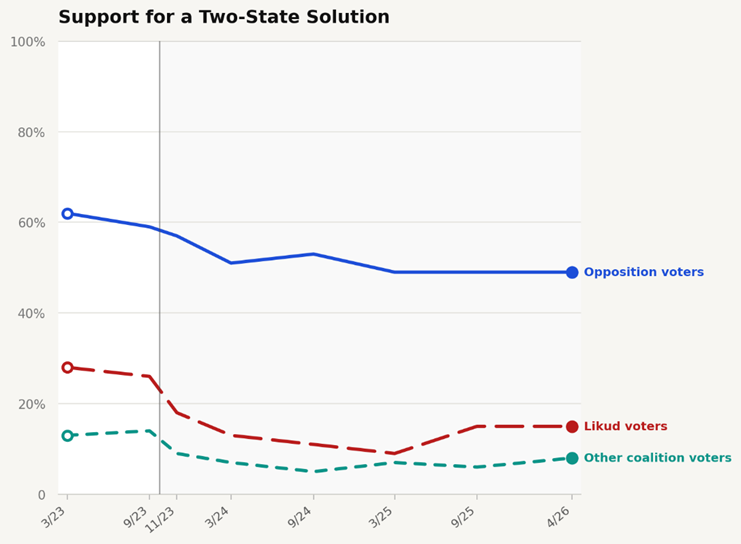
So, how have Likud voters' positions changed on various issues, and how have they changed compared to the positions of voters of the other coalition parties and the positions of opposition voters? For convenience, a minority of the results are shown in the charts below, and all the charts are shown here. First, the security issues: Among other things, we asked about support for the two-state solution, support for annexing part of the West Bank, and support for the death penalty for terrorists convicted of murder. The chart below, which presents the average support for a two-state solution among the various groups, shows that throughout the current term, Likud voters' positions have been closer to the positions of the other coalition voters than to the positions of opposition voters. Similar findings are also found in questions about support for annexing part of the West Bank and support for the death penalty for terrorists convicted of murder.
 |
Likud voters are also closer to voters of the other coalition parties than to voters of the opposition parties with respect to two legal-constitutional issues that we asked about: agreement that the Supreme Court should be stripped of the authority to annul laws passed by the Knesset (see chart below) and support for the override clause. Although there are differences of about 15-20 percentage points over the period between the averages of Likud voters and those of voters of the other coalition parties, the gaps between Likud voters and voters of the opposition parties are much larger: about 40-50 percentage points. These differences are even larger than the differences between Likud voters and voters of the opposition parties with respect to the security issues noted above, and they remain fairly similar throughout the period, especially after October 7, 2023.
 |
Throughout the current term, Likud voters have also been much closer to other coalition voters on issues of freedom of expression and (lack of) willingness to accept criticism of the state. Their level of support for ensuring freedom of expression for people who speak out against the state is similar to that of voters of other coalition parties, but is 30-40 percentage points lower than that of opposition voters. We also found similar findings regarding the level of support for preventing public activity by an Israeli organization that strongly criticizes the state and for banning the activity of international organizations operating in Israel that strongly criticize the state. This may be related to a very widespread perception among all voters of the coalition parties, including the Likud, that there are those in Israel who abuse freedom of expression to harm Israel: according to the Israel Democracy Institute's Democracy Index 2025, about 90% of voters of the coalition parties agreed with this claim, compared to a lower percentage among voters of the opposition parties.
We also found a similar pattern regarding the rights of the Jewish majority in the State of Israel. Likud voters, like the rest of the coalition voters, agreed much more than opposition voters with the statement that Jewish citizens in Israel should have more rights than non-Jewish citizens. Similar findings were also found regarding the question of agreement that the right to vote in elections should be taken away from those unwilling to declare that the State of Israel is the nation-state of the Jewish people.
However, in response to the question about preference for a Jewish state or a democratic state when there is a contradiction between them, relatively large differences, of about 30 percentage points, can be seen throughout the period between Likud voters and the rest of the coalition voters (see the chart below): Slightly over 50% of Likud voters prefer a Jewish state over a democratic state in a situation of contradiction between them, compared to over 80% of the rest of the coalition voters. In contrast, among opposition voters, the figure is about 10%. It seems that in this debate, Likud voters are largely in the middle.
 |
These findings lead us to the key difference in our data between Likud voters and the rest of the coalition voters: civic, state-religion issues. Throughout the period, Likud voters are closer in their positions to opposition voters than to the rest of the coalition voters when it comes to support for public transportation operating on Shabbat throughout the country (excluding areas with a Haredi or religious majority) (see chart below). We also found similar patterns with respect to support for civil marriage in Israel and support for same-sex couples having the same legal rights in Israel as other couples.
 |
It should be noted that on the issue of ultra-Orthodox conscription to the IDF, there are also clear differences between Likud voters and other coalition voters. In a survey we conducted at the Institute for liberty and Accountability in July 2025, we asked about support for widespread conscription of young ultra-Orthodox people to the IDF. Eighty-three percent of Likud voters supported this, compared to 87% of opposition voters and only 41% among other coalition voters. Therefore, it seems that on civic issues, as well as regarding ultra-Orthodox conscription, the differences between Likud voters and other coalition voters are the greatest.
In light of all this, it appears that, except for civic, state-religion issues and the issue of the Haredi conscription, over the past three and a half years there has been a significant similarity between the positions and perceptions of Likud voters and voters of the other coalition parties – alongside significant differences from opposition voters. Of course, this does not guarantee a similar coalition composition after the next elections; but, for now, it seems that if the main issues the Israeli public will face will be either security issues or legal-constitutional issues and the status of the Supreme Court, Likud voters will be more comfortable cooperating with voters of the other parties in the current coalition than with voters of the opposition parties.
Dr. Omer Yair is the research director and a research fellow at the Institute for Liberty and Responsibility at the Lauder School of Government, Diplomacy and Strategy at Reichman University.