Accessibility menu



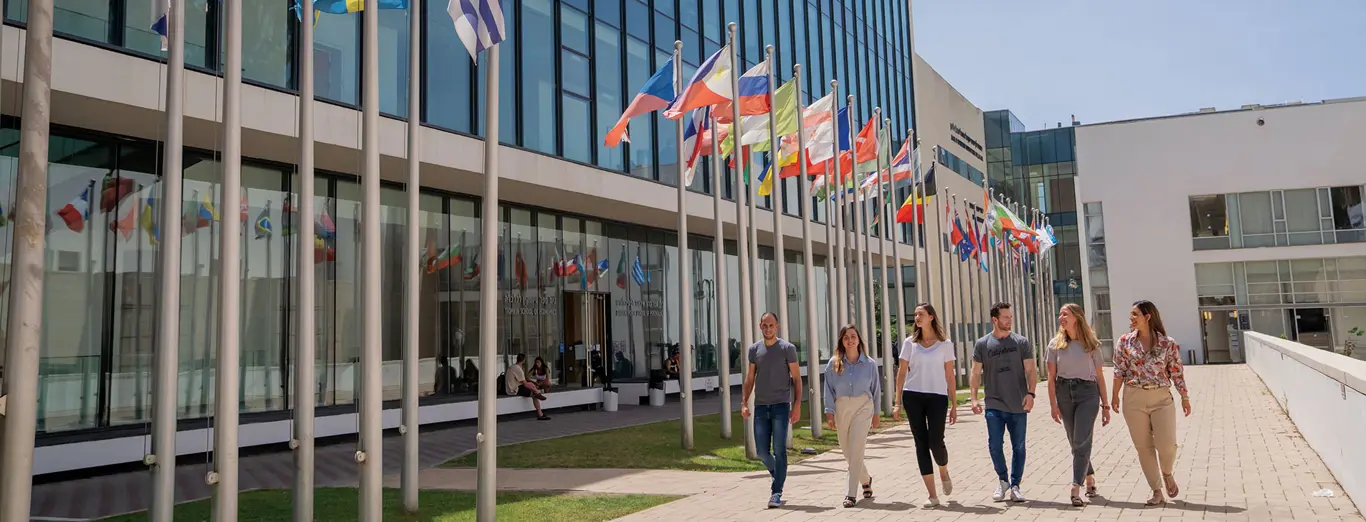
MA Government Diplomacy & Conflict Studies
MA Government Diplomacy & Conflict Studies
 Apply
Apply Faculty
 Brochure
 Head of Program
About The Program
- Students will be equipped with a holistic understanding of conflict and diplomacy including their cultural and legal aspects.
- The program emphasizes the acquisition of tools for dealing with conflict: negotiation, mediation, public diplomacy, post-conflict reconstruction, and track-two engagement.
- The program provides students with opportunities to obtain practical experience through individual internships, research groups, and policy-oriented work with highly experienced scholars and practitioners.
The program offers two certificate-granting elective clusters:

Specialization with Thesis Track
Upon completing the program, students may apply to the Thesis Track in order to fulfill the requirements for the MA in Government, specializing in Diplomacy and Conflict Studies with a Thesis
* Students with career goals in the US armed services, graduates of AF/N/ROTC Programs, or Military Colleges please click here to learn more about the ASL Scholarship.
* To apply for the MA Government Program please click here.
What Will You Study?
-
Diplomacy and Conflict Studies Specialization Courses 16 Credits
-
MANDATORY
This course offers an in-depth exploration of the conduct of international relations and contemporary diplomacy in an increasingly interconnected and globalized world influenced by revolutionary technological change. The course traces the evolution of diplomacy over history, and analyzes how globalization has transformed the ways in which diplomacy is conducted. We will introduce the concept of complex diplomacy, highlighting its theoretical and practical dimensions. Topics include the influence of non-state actors, technological innovation, genderized diplomacy, public diplomacy, disaster diplomacy, and the role of international law and lawfare. The course is based on both theoretical learning and interactive exercises.
-
Prof. Amnon Cavari
This course analyzes the development and modern practice of presidential leadership in the United States. It examines the evolution of the modern presidency, the process of presidential selection, the powers and responsibilities of the presidents and the structure of the presidency as an institution. It explores the relationship of the presidency with other major governmental and extra-governmental institutions, the press, and the public. Its primary concern is with the political resources and constraints influencing the ability of presidents to provide leadership in the U.S. political system.
-
Psychological dimensions are a very significant component, some will say the major component, in the formation of conflicts. Conflicts intensify because of the parties' perception of each other, lack of trust between them, difference in their judgement of "reality", and their tendency to distance themselves from each other. Over the years, societies also create an ethos of conflict and a whole repertoire of opinions and attitudes that make the end of the conflict almost impossible because it constitutes a fundamental and essential part of their identity. As a result, even when conflicts can seemingly be resolved, the parties fail to bring themselves to it. Yet on the other hand, it is precisely through changes in perception and understanding of conflicts that parties can be brought together. The ability to change positions and perceptions, the willingness to create a dialogue with the opponent, the willingness to apologize and the attempt to recognize the narrative of the other – are all significant factors that shape the nature of future relations between the parties. The course will present approaches to the understanding of conflicts through the prism of social psychology and how these approaches propose to resolve conflicts. It will be based on theoretical research and examples from various conflicts.
Data, AI and Technology Cluster Credits 10
-
This course will provide students with a deep understanding of the current normative, policy and enforcement challenges associated with cybersecurity, cyber terrorism, and terrorist use of the internet. It will also discuss the future trends in the legal and policy aspects of counter-terrorism in cyberspace, including the impact of Artificial Intelligence. The course is divided into six modules, three modules taught by each of the lecturers. The aim of the course is to address the most up-to-date legal, policy and technological developments in countering the cyber threat in the context of counterterrorism. Each module will be divided into two sections, covering a total of twelve subjects. Topics that will be discussed include the following: cyber as a military combat arena; basic definitions and comparisons to the physical arena; hybrid conflicts (cyber and physical), the actors in cyberspace, including non-state actors and proxies; choosing targets in cyberspace; the roles of countries, organizations and security agencies; cyber defense and offense; cyber intelligence, including open-source intelligence; counter-measures at different levels; countries’ strategic preparations; the impact of Artificial Intelligence on counter-terrorism measures; decision-making in response to a cyber event; defending critical infrastructure; the Internet of Things (IoT) and its influence on cyberspace; threat mitigation techniques; encryption, and artificial intelligence in cyberspace. Several selected events and case studies will be analyzed during the course
-
The course is geared toward participants at the decision-making level, and its goal is to provide an introduction to cyber-security. In the course we will discuss the main concepts of cyber-security, how to define and manage an organizational cyber-security policy, and will review how security is implemented in IT systems, the web, the cloud, and mobile devices. We will discuss how to prevent cyber attacks as well as how to detect cyber attacks, and both the defense and the attacker perspectives will be addressed. In addition, we will discuss how the AI era is affecting cyber security.
Contemporary Middle East Cluster Credits 12
-
The course will deal with topics related to various aspects of the Palestinian politics and to the negotiation-process of the Israeli –Arab conflict, with emphasis on the Israeli-Palestinian arena. We will analyze historical and political processes such as the emergence of Palestinian nationhood, Palestinian historical worldview, ethos and narratives as well as the Palestinian politics from 1948 and on, and the different stages of Israel-Palestinian relations and peace initiatives such as the Oslo Accords, the Arab Peace Initiative, the Annapolis process and the current situation.
Elective Courses Students select 10 credits from the courses listed below. In addition, Foundation/Specialization/Cluster courses can count as electives, unless already taken.
-
Mediation has become one of the most widely used methods for the resolution of inter and intrastate conflict in the global system. Yet, not all conflicts are mediated and not all mediation attempts succeed. In this course, we will survey and analyze the practice and theory of mediation. Using historical examples, we will explore the perspectives of the mediator and the disputing parties with regard to mediation; analyze strengths and weaknesses of different types of mediators, explore the strategies and tactics used by mediators under different conditions. Special attention will be devoted to issues regarding the motivations for and costs involved in mediation in international conflicts, mediators' roles and styles, trust issues, and power concerns. We will assess the contribution of different theoretical concepts to our understanding of mediation processes, while examining their limitations in light of the complexities that characterize the international system.
-
*For the entire list of courses please refer to the Student Handbook
*The academic administration of Reichman University reserves the right to make changes to the curriculum.
A graduate who has completed a thesis and specialization will receive an MA Diploma on which the completion of the thesis and specialization will be noted.