


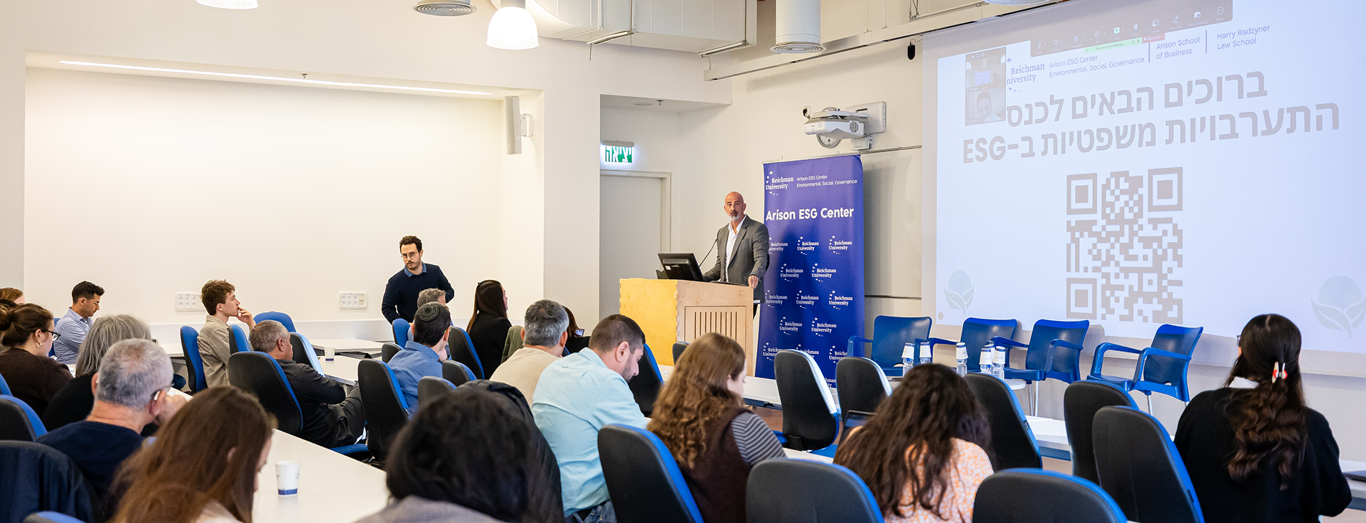
On Monday, January 26, 2026, an academic conference on Legal Interventions in ESG was held at Reichman University.
Accessibility menu
Academic Conference on Legal Interventions in ESG
Academic Conference on Legal Interventions in ESG
 Photo gallery from the conference
 Full conference video
On Monday, January 26, 2026, Reichman University hosted an academic conference on legal interventions in ESG, initiated by Arison ESG Center, Arison School of Business, and the Harry Radzyner Law School. The conference addressed the rapid evolution of ESG regulation and the role of law in shaping the boundaries of corporate responsibility, offering a critical examination of existing and emerging legal tools.
The conference was moderated by Dr. Shahar Hadar, Adv., Partner at Meitar Law Offices, who facilitated the discussion across academic, legal, and practical perspectives, highlighting the tensions between regulation, enforcement, and voluntary market initiatives.
As part of the conference, leading scholars presented recent research addressing diverse aspects of legal intervention in ESG:
- Hon. Judge Dr. Michal Agmon-Gonen (Research Fellow at Arison ESG Center) presented a position paper on private enforcement of ESG, including contemporary examples of legal proceedings worldwide.
- Prof. Moran Ofir (Faculty of Law, University of Haifa) examined the boundaries of environmental disclosure, questioning whether financial instruments (such as green bonds and CoCo bonds) effectively mitigate greenwashing, and shared insights from behavioral studies on investor preferences regarding environmental investments.
- Prof. Eli Bukspan (Harry Radzyner Law School and Arison ESG Center) discussed shareholder preferences and voting on corporate purpose in company bylaws as a tool for advancing corporate democratization, addressing both its potential and its limitations.
- Prof. Roy Shapira (Harry Radzyner Law School) presented research on ESG legislation in the European Union and its impact on non-European companies and their officers, including a discussion of the extraterritorial implications of EU regulation on global business activity.
The conference highlighted that legal interventions in ESG are not merely a regulatory issue, but rather a dynamic arena where law, markets, investors, and civil society intersect. The discussions underscored the need for a multidisciplinary, critical, and research-based approach, alongside a deep understanding of the practical challenges faced by companies operating in an evolving regulatory environment.
Arison ESG Center thanks the speakers, moderator, and participants for a rich and insightful discussion, and continues to promote academic and practical discourse on corporate responsibility, regulation, and ESG in Israel and globally.


