


On Thursday, July 16, 2026, the Arison ESG Center at Reichman University convened a roundtable at Margalit Startup City in Kiryat Shmona
Accessibility menu
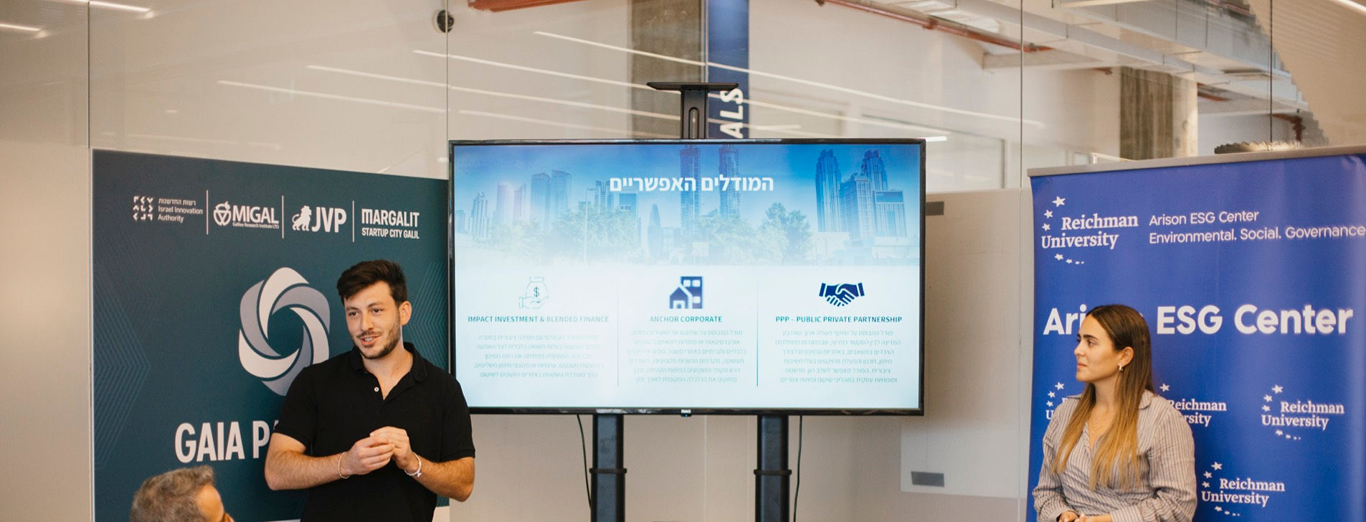
Roundtable: “The Business Sector as a Driver of Recovery and Regional Development in Northern Israel”
Roundtable: “The Business Sector as a Driver of Recovery and Regional Development in Northern Israel”
 Agenda and working-group allocation
 Participating organizations
 Opening remarks
 Photo gallery
On July 16, 2026, the Arison ESG Center at Reichman University convened a roundtable at Margalit Startup City in Kiryat Shmona to examine the role of the business sector in the recovery and long-term development of northern Israel. The central question guiding the meeting was how to transform business involvement from isolated, philanthropic, or reactive initiatives into an institutionalized, strategic, and sustainable partnership capable of contributing to economic growth, high-quality employment, innovation, and stronger local communities.
The discussion began from the premise that government action is essential to the recovery of northern Israel, but cannot by itself create a stable foundation for long-term regional growth. Meaningful development in the Eastern Galilee and Upper Galilee requires cooperation among the government, local authorities, companies, industries, employers, investors, academic and research institutions, philanthropic organizations, and civil society.
Accordingly, the roundtable sought to identify the structural barriers hindering the region’s development, the business sector’s areas of comparative advantage, and the models through which its involvement could be institutionalized.
The discussion was informed by a policy paper on integrating the business sector into the recovery of local authorities in crisis-affected regions. The paper was prepared under the leadership of Dr. Jennifer Shkabatur, Vice Dean of the Lauder School of Government, Diplomacy and Strategy at Reichman University, together with Maor Atias and Ron Kuperfish, interns at the Arison ESG Center.
During the meeting, participants discussed the region’s structural barriers and key needs and considered possible models for action, including regional anchor institutions, public-private partnerships, impact investment, blended finance, local procurement, and the strengthening of regional supply chains.
Following the plenary discussion, participants divided into working groups to map the assets, needs, and gaps of the Eastern Galilee and Upper Galilee. The regional assets examined included academic and research institutions, agriculture, tourism, industry, entrepreneurship, and local communities. The purpose of the discussion was to explore how these assets could be connected, how barriers preventing them from becoming engines of growth could be removed, and which practical initiatives or pilot programs could be advanced in the short and medium term.
Participants included representatives of government ministries and public bodies, including the Ministry of Economy and Industry, the Small and Medium Business Agency, the Israeli Employment Service, and the Northern Momentum Directorate; representatives of Tel-Hai University, the MIGAL Galilee Research Institute, and the Regional Knowledge Center; companies, industrial enterprises, and investment organizations, including GAIA Partners, the Northern Israeli Tech Fund, the Fresh Start FoodTech Incubator, abra, Shamir Optical Industry, and the Galilee Development Company; as well as philanthropic organizations, cross-sector partnerships, and civil society initiatives, including the Social-Economic Forum of the Israeli Business Sector Presidency, Jewish National Fund-USA, Habayta — Returning to the Galilee, Lobby 1701, and Matzpinim.
The broad range of participants reflected the understanding that sustainable regional development requires the integration of local knowledge, public policy, capital, technology, implementation capabilities, and civic leadership.
The roundtable was intended to serve as the starting point for an ongoing process. The next challenge is to translate the knowledge and insights generated during the meeting into practical initiatives, identify areas in which the business sector can provide clear added value, and develop partnerships and pilot programs that will contribute not only to post-crisis recovery, but also to the creation of a stable economic, employment, and community foundation for the Eastern Galilee and Upper Galilee.
