


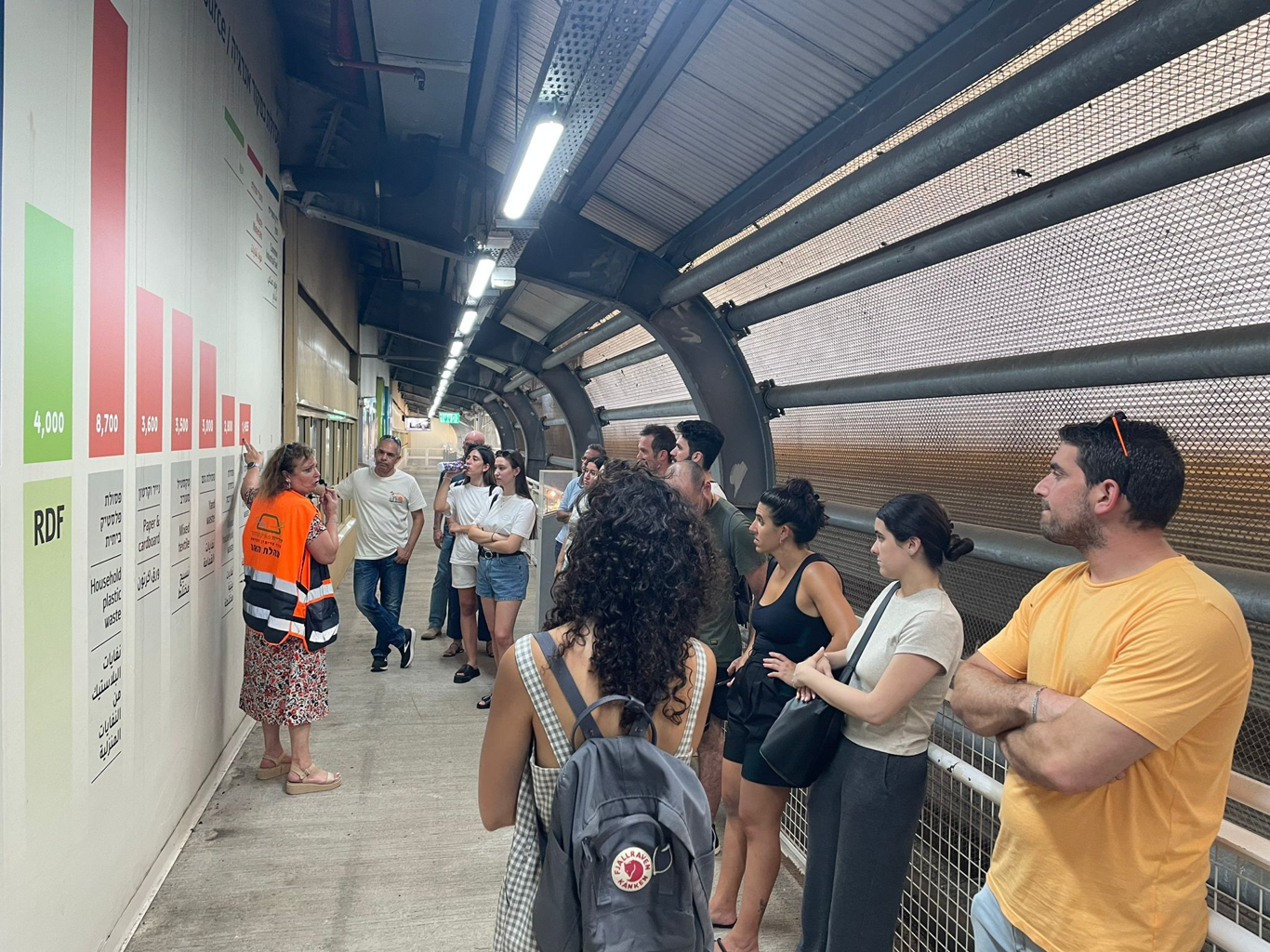
On Monday, July 22, 2024, students from the internship program participated in a tour of the Hiriya Recycling Park and Environmental Education Center. The tour, led by Riva Waldman, Director of Communications, External Affairs, and Education, was titled “So, where does our garbage go, and who deals with it?
Accessibility menu
Tour of Hiriya Park 22.7.24
Tour of Hiriya Park 22.7.24
So, where does our garbage go, and who deals with it? We visited the Hiriya Recycling Park and Environmental Education Center, where we were guided by Riva Waldman, Director of Communications, External Affairs and Education.
The Gush Dan region alone generates approximately 3,000 tons of mixed household and industrial waste per day. The Hiriya Recycling Park is the largest body in Israel responsible for managing waste. It operates as a municipal corporation that includes several municipalities — Tel Aviv, Ramat Gan, Holon, Givatayim and Bnei Brak — and serves about 30 other municipalities, catering to almost two million residents.
Hiriya has a long history. Once a landfill that grew into a mountain of garbage and the highest point in Gush Dan, in 1998, a decision was taken to close it and establish in its place a recycling park to handle waste more effectively, benefiting both the environment and residents.
The park houses several facilities for advanced waste treatment, including sorting processes, energy production from waste, composting, treatment and reuse of construction waste, and treatment of tree trimmings. Every year, the plant and its facilities process over 1.25 million tons of waste.
The park’s most prominent facility is the RDF (Refuse Derived Fuel) plant — a new, advanced facility based on a circular economic model that converts garbage into fuel. The plant receives about 2,000 tons of waste per day, and uses advanced methods to automatically and mechanically sort dry/wet waste, metals, plastic, and bags. These products are repurposed for use in other facilities, while the remaining waste is shredded into small particles and converted into high-quality fuel for the "Nesher Ramla" cement factory.
We also toured the impressive Environmental Education Center, which features exhibitions that inspire thought and creativity. The center serves as the park’s educational arm, aimed at raising awareness about the waste we generate, consumption culture, the methods we use to manage waste, and its impact on the environment. The center works to build strong relationships with local residents, especially students, through a variety of activities, tours, and lectures.
At the conclusion of the tour, we enjoyed coffee and a light meal at the “Hiriya Cafe,” a social-environmental initiative situated in the heart of the recycling park. It is run by a chain of social cafes (“Cafe Tov”) that provides employment opportunities to individuals facing challenges in the job market.
In conclusion, waste serves as a mirror to our society, reflecting our consumption patterns, usage habits, our approach, and the responsibility each of us bears for the waste we produce on a daily basis. Waste is a serious issue that demands attention; we cannot afford to bury our heads in the sand. Waste has economic, regulatory, social, and especially environmental and health implications.


