


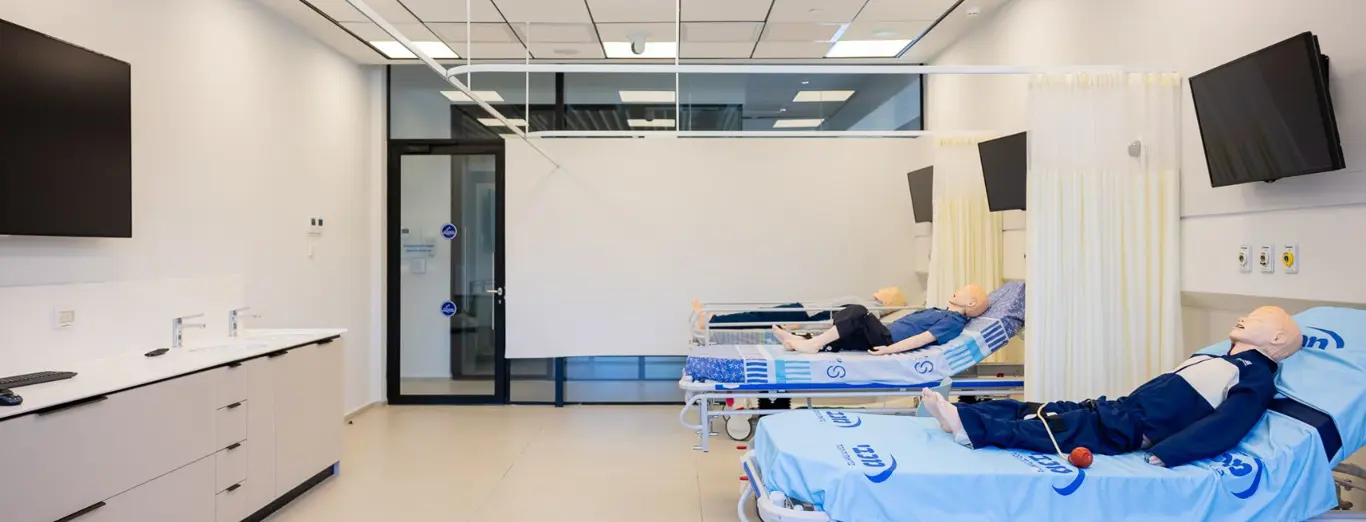
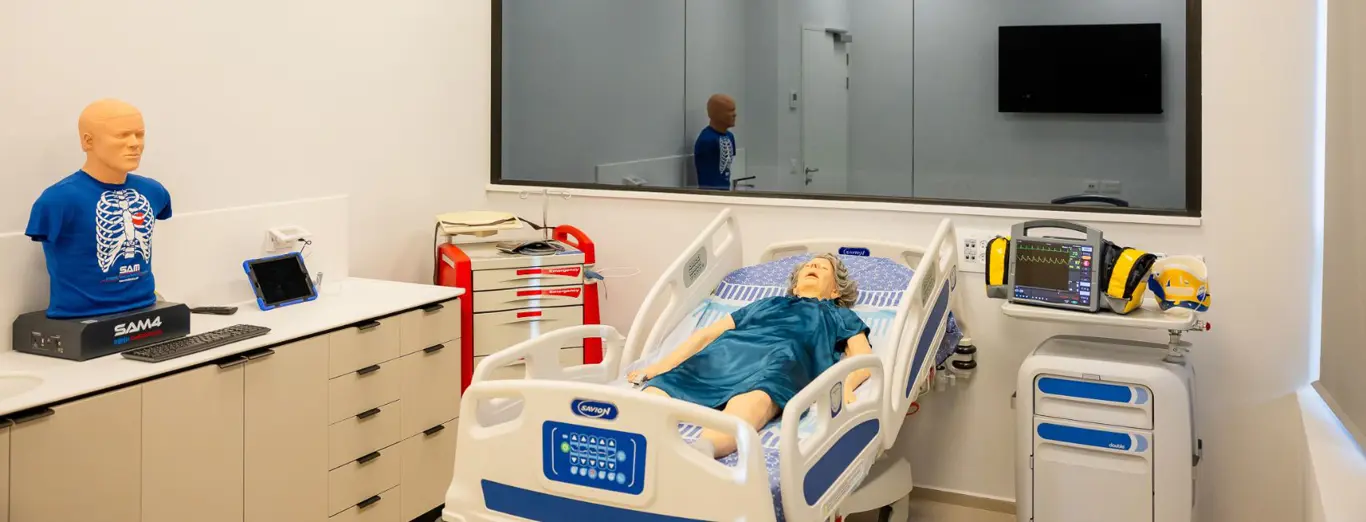
The Center for Medical Simulation and Education at Dina Recanati School of Medicine includes 10 simulation rooms for personalized training, as well as spaces designed to replicate emergency rooms. The center is equipped with advanced technologies, including smart mannequins, VR headsets, a control room, and more. This center, the most advanced in Israel, provides a comprehensive training platform for students, physicians, medical teams, and organizations, all of whom benefit from its infrastructure and services. In addition, the center is fully available to Reichman University medical students and faculty members affiliated with the university.
Accessibility menu
The Center for Medical Simulation and Education
A learning and training facility for organizational and individual excellence
The Center for Medical Simulation and Education
A learning and training facility for organizational and individual excellence
The Center for Medical Simulation and Education

Dr. David Maiershon
Vice Dean for Assessment and Head of the Center for Medical Simulation and Education

Reli Shalom
Director of the Center for Medical Simulation and Education
The field of medical education is constantly evolving. Advances in medical knowledge, technology, and understanding of the importance of patient safety require innovative training methods. While traditional medical training methods serve as an important foundation, they often fall short in addressing today’s complex challenges.
Medical simulation is a modern and essential training methodology that bridges the gap between theoretical learning and real-world clinical experience. It provides a safe and controlled environment for learning and developing skills without the risk of harming patients.
What is a center for medical simulation and education?
A center for medical simulation and education is a dedicated facility designed to replicate real-world medical settings and treatments for educational and training purposes. It is important to note that simulation is first and foremost a technique (not a technology) that aims to replace and enhance real-life experiences through guided practice.
Benefits of using a simulation center:
• Risk-free practice: Learning from mistakes without endangering real patients
• Exposure to rare and critical cases: Experiencing, learning, and managing extreme situations
• Development of technical skills: Hands-on practice of essential medical procedures, leading to improved skill and muscle memory
• Enhancement of soft skills: Strengthening communication, teamwork, leadership, decision-making, and resource management skills in crisis scenarios
• Objective assessment and feedback: Recording, reviewing, and evaluation of performance and providing of real-time feedback
• Increased self-confidence and reduced anxiety: Repeated practice in a safe environment builds confidence and enhances readiness for real-world clinical situations
• Personalized learning for diverse needs: Addressing a wide range of learners and creating customized training experiences
• Improved systems integration: Optimization and streamlining of healthcare organizations and systems and disaster response protocols
Types of medical simulations offered at Reichman University:
• Simulation using skilled actors portraying patients and/or clients in complex scenarios
• Mannequin-based simulation: Use of smart mannequins that replicate a variety of medical situations, enabling the learning of advanced skills
• Virtual reality (VR) simulation: Technologies that provide realistic and interactive virtual environments for practice
• Skill-based simulation: Practice focused on skills such as intubation, catheterization or injections, ultrasound, and more
• Hybrid simulation: A combination of different simulation methods, for example, using a mannequin alongside interaction with a standardized patient
Workshops and courses offered at the Center for Medical Simulation and Education:

Medical training and emergency room management

Point of Care Ultrasound (POCUS) training

Business training in negotiation and decision-making

Human capital management and development

Communication, customer service, and client relations
What makes the Center for Medical Simulation and Education at Reichman University unique:
A team of experienced and highly skilled professionals supports each organization prior to and during its use of the center’s infrastructure

The center is equipped with the most advanced and innovative technologies in Israel, including a VR/XR lab and 3D printers

A wide range of spaces allows for maximum flexibility, including large halls for real-time scenario and event analysis


-
Point of Care Ultrasound (POCUS) Training

This training provides the tools and skills needed to use point-of-care ultrasound for rapid diagnosis in a clinical environment, eliminating the need for referrals to imaging centers. Participants learn how to conduct focused ultrasound examinations and apply their findings to make real-time decisions. The training is designed for medical staff seeking to integrate advanced technology into routine clinical practice.
-
Promoting Groundbreaking Research
The center advances research to improve medical education, clinical performance, and patient outcomes. Research focuses on developing innovative teaching models, evaluating learning processes, and enhancing healthcare systems through advanced technologies. The center also promotes research aiming to optimize medical emergency responses and improve cooperation among medical teams.
For more information:
Reli Shalom, Director of the Center for Medical Simulation and Education